

Stranger’s Guide explores how politics, power and culture shape daily life across the globe. We believe that local writers, journalists and thinkers are best equipped to explain their political and cultural realities and we publish stories that ask us to listen to the complexities of the world.
Weekly Long Read is for everyone but it’s made possible by our paid subscribers. Thanks to those who support our work, and if you’re not yet a paid subscriber, today is the perfect day to join!
Corkscrews
by Gabrielle Bellot
Stranger’s Guide: The Caribbean
One night, when I was young, the woman who helped us around our home ran her hands through my then-short curls. “You have nice hair,” she said in her dark voice, rounded face smiling. Her hand was large and faintly callused, her skin the deep brown of rained-upon wood. “Soft.” I was sitting on her white, rumpled bed in the little room my parents had converted for her, where she could go if she wanted to rest. It was not uncommon for Dominicans to have helpers who assisted with things around their homes, and this woman, who lived in a small house higher up in the village of Giraudel, had come to feel like part of our family after years of her walking the winding mountain road to our home each morning, which was hidden behind patches of forest and fields of razor grass flecked with chartreuse clumps of bamboo. She was thickset and strong but kind, and her own hair, which was tighter-curled than mine, was either hidden under a wrap or pulled back in short cornrows. I don’t remember what I said, but I know I felt a slight confusion, because what she was telling me conflicted with what my mother always declared.
My mother never wanted my hair loose and long. “Your hair is coarse,” she would say. “You don’t have good hair. It will never look good. You don’t want that.” She seemed convinced that my black corkscrew curls could never be proper—propriety the faintly British-colonial ideal she still lived by decades after our independence from Britain. Her own hair was almost always straightened, curled only faintly at the ends and dyed a glittering reddish or a deep brown; she looked beautiful, the hair framing her slender, light face, but for many years I didn’t even know that my mother had curls like mine. She hid them. It was only when she was coaxed into the sea or into a pool, without a haircap, that her true hair began to emerge, tight swirls she hid in a ponytail until she could go again to the salon her sister owned in the capital city. My father, who was the darkest-skinned in my immediate family, had obvious curls, but he kept his hair short, so I never knew just how tight they were.
It was complicated by the fact that I wanted to be accepted as a girl, yet everyone called me a boy. I knew that I wanted to be a girl from a very young age, but I had no concrete language for that internal sense; I wouldn’t even know the word transgender existed until I was a teen. In Dominica, queerness wasn’t an identity I could openly wear. On the radio and in church, evangelicals denigrated homosexuality as an iniquity that the Americans and Europeans were trying to force upon us; the Prime Minister declared in 2014 that Dominica would “never accept same-sex marriage” as long as he was in power (and it’s unlikely other prime ministers would be more lenient). Because I seemed stuck, somehow, in the wrong body, I had been sent to a religious all-boys primary and secondary school, where we were required, to my silent frustration, to have short haircuts; long hair, it seemed, was devilish.
I tried to breathe, slowly, rigorously, mantra-like, the way I would later learn in Dominica is how you breathe while scuba diving. I tried to keep myself calm, so that I would not sink, so my bubbles, drifting up like brief jellyfish, would not stop. I didn’t understand why the girl inside me refused to go away even when I tried to calm myself down, even when I read the Bible, even when I condemned and cursed her.
Even with short hair and trying to pretend to be macho to keep anyone from learning my secret desire to be female, I was shy and awkward, and it wasn’t long before people began picking on me at school for it. People pushed me around. Once, a group of laughing students asked me if I preferred a drawing of a penis or a vagina; once, a boy dropped a rock on my head; one time, people called me a buller or boggerah, the terms we used for gay persons; another time, a boy told me I looked like a girl and didn’t belong in a boys’ school. Secretly, I was happy to hear this last comment, but I was terrified all the same. I only escaped worse violence through my association with my cousins, who were well-known as “cool;” without them, I know I would have been stoned and beaten up more.
As a teen, after I graduated from secondary school, I had a little more freedom, so I began to grow out my hair. Longer hair on men wasn’t uncommon in Dominica, at least if it was tied back, in dreadlocks, or in cornrows; most of the young men who grew out their hair were trying to imitate American rappers who had done the same, as American hip-hop had an outsized influence in our island. But this, of course, wasn’t what I wanted; I wanted to do my hair like my female cousins and girlfriends did. I was lost. I felt like a dinghy without a captain, sent adrift into the Atlantic into that particular patch of sea where the world seems to stop and all you can hear is the quiet bones of old shipwrecks played upon by the water.
When I told my mum I was considering putting my hair into dreads, she looked at me with the impassable sternness of a statue. “Do that,” she said, “and you’ll sleep outside with the dogs.”
So I wore my hair in a perpetual ponytail or low bun. It felt hidden; more than anything, I wanted to wear it out, so that it brushed my shoulders. But I lived so deeply in the closet then, knew the scent and roughness of the wood so well, that I felt afraid to wear it down in public.
I hid in that closet for most of my life. In Florida in graduate school, I came close to killing myself with poison, so unwilling was I to keep up the charade of being perceived as male. I came out, finally, as trans, knowing that I would never be able to live as a woman openly back home in Dominica—and when my mother told me the same, told me I was her shame, I cried, but I understood, too, even as she did not understand me. I felt like I had lost an entire world, the place where my memories, even now, still live brightest—but I had gained a new world, as well, one in which I finally felt right. I was haunted, still; my mother’s condemnations rang loud in me like the sound of your breaths when you scuba dive, but I could live with that ghostly voice, somewhat, if I could live as my truest self.
I let my curls down in public, and everything changed.
…
In 1974, the government of Dominica, then led by Patrick John, passed one of the most remarkable bills in the history of the island, if not the Caribbean as a whole: the Dread Act, which authorized the police to arrest and even, in certain circumstances, kill people wearing dreadlocks on sight, without requiring warrants. “Dreads,” as the dreadlock-wearers were known in the bill, inspired their namesake in the country: a pervasive paranoia that people who had such hairstyles were violent, seditious and worthy of incarceration or death. And the bill went beyond mere hairstyles, allowing the imprisonment, often for up to nine months, of people who simply possessed memorabilia associated with Dreads in general. A Dread who took a single mango or coconut from someone else’s land could easily face mandatory jail time, despite the inconceivability of such an “offense” prompting any response from the authorities if Dreads were not involved. If Dominicans found Dreads dwelling “illegally” in households—a criminally vague description—they were allowed to kill them; police officers and security forces could receive immunity if they murdered Dreads.
The bill was repealed in 1985, but by then, an estimated twenty-one Dreads had been killed. The number may seem low, but the fact that any Rastafarian—for it was primarily followers of the Rastafarian faith whom the bill targeted—died as a result of this discriminatory legislation is unacceptable. Beyond this, it’s impossible to know how many other Rastafarians might have been killed without being recorded at all, given the legal ease with which one could brush such homicides under the rug. Given the many raids that the authorities conducted while the bill was in effect, it’s likely that the death toll is higher. It’s likely that many ghosts whose names and faces were lost to our history books haunt the mountains, still hearing the gunshots that released them from their bodies four decades ago.
“Love is Earth’s mission / Despite the massed dead,” the Jamaican poet Anthony McNeill wrote in the final lines of what is perhaps his best-remembered poem from Chinese Lanterns from the Blue Child, a poetry collection McNeill completed just before his death in 1996. It is a simple statement, almost clunky in its cadence, yet it has stayed with me for years. It comes back to me now, as I think of those ghosts, those forgotten dead, and the way that such legislation is so often presented not as an act of hatred, but one of love, one of protection and safety. Yet this bill—little-remembered even in Dominica to this day—was hardly crafted out of love; it was written, instead, out of a desire for death. It was written, we are meant to believe, to stop terror, when its very means to do so were to allow our citizens to engage in acts of terror against innocent civilians.
At moments like these, I think of McNeill’s lines, again,
and I wonder if this Earth has any discernible mission at all.
…
I like those curls, ma. You so curly. Rock it natural. Beautiful. I want to live in those curls. Yes, my sister.
I began to hear these comments from men once I started to present as female in public in America. I would walk down the streets, sit in the subway, sit at a bar, exist as a profile picture on a dating site—it didn’t matter. Men sexualized me immediately, and if it wasn’t my lips or my eyes, it was my hair, which I now wore down almost exclusively, my ringlets (when my hair was not too frizzy to form ringlets) brushing my shoulders and nape as I walked.
My hair taught me something in these interactions: that in America, with hair like mine and skin of this olive brown, I was as often perceived to be Hispanic as black. Back home, I was a shabine, a neutral-to-positive term we used for mixed-race people with skin anywhere from mango to murky olive, but in America, I was suddenly fully one thing or the other, as if the one-drop rule was back in full effect—and, of course, the one-drop rule has never vanished, but simply evanesced into the background. If I wore my hair up in a bun with hoop earrings, men were more likely to catcall me in Spanish; if I wore it up with drop earrings and red lipstick, Indian men occasionally asked me if I was Indian; with my hair down, I was just about anything.
It was a surprise, the way that wearing my hair up or down so totally transformed how strangers viewed me. All my life, I had grown accustomed to people asking what I was, ethnically, but now, out as a woman and with my hair down, people seemed more certain than ever. My hair had become a marker of my identity in a way I had never imagined possible. And it was far from the coarse mess my mother tried to get me to hide; it had become, instead, one of my little mundane superpowers, the thing people often noticed about me first and remembered most of all afterward.
…
The Dread Act did not come out of nowhere. It was an amendment to the larger Prohibited and Unlawful Societies and Associations Act, and it appeared in Parliament after a series of attacks in the south of the island by people wearing their hair in matted locks. These incidents, which targeted tourists and local farmers and families, engendered widespread panic and people began to imagine that anyone who wore dreadlocks might engage in arson or other sorts of violence. It was unfortunate, given that the majority of Rastafarians followed a firm code of peaceful coexistence with everyone else; due to the acts of a few, all Rastafarians suddenly became potential terrorists in the eyes of the law. Many fled into the mountains and less obviously accessible parts of the island, sometimes utilizing paths that the escaped Maroons had used centuries before. Dreadlocks had become political dangers in a way almost unprecedented anywhere else in the region.
The era of the Dread Act was a remarkable time in Dominican history. Four years after the Act passed, Dominica became independent from Great Britain; the following year, Hurricane David famously devastated the island; the year after that, Eugenia Charles took office, becoming not only Dominica’s first female prime minister, but the first in the Caribbean as a whole. Yet amidst all of this political progressivism and tempest destruction, Rastafarians were constantly ostracized. If the island had gained its independence, its dreadlocked inhabitants had acquired just the opposite.
But perhaps the most remarkable—and also least remarkable—thing is how few people seem to know about this period in our history. Whenever I or someone else brings it up, it is almost always met with wide eyes and expletives; it seems extraordinary to them, most of the time, that this period has been so thoroughly forgotten, even in an era where it is frustratingly banal to see yet another story of some dreadlocked or natural-hair-wearing woman told she must “fix” her tresses to look more “professional.” But Dominica, like many islands in the Caribbean, is a place where we forget things quickly, where ghosts roam all of our roads and hills, but we rarely see them.
…
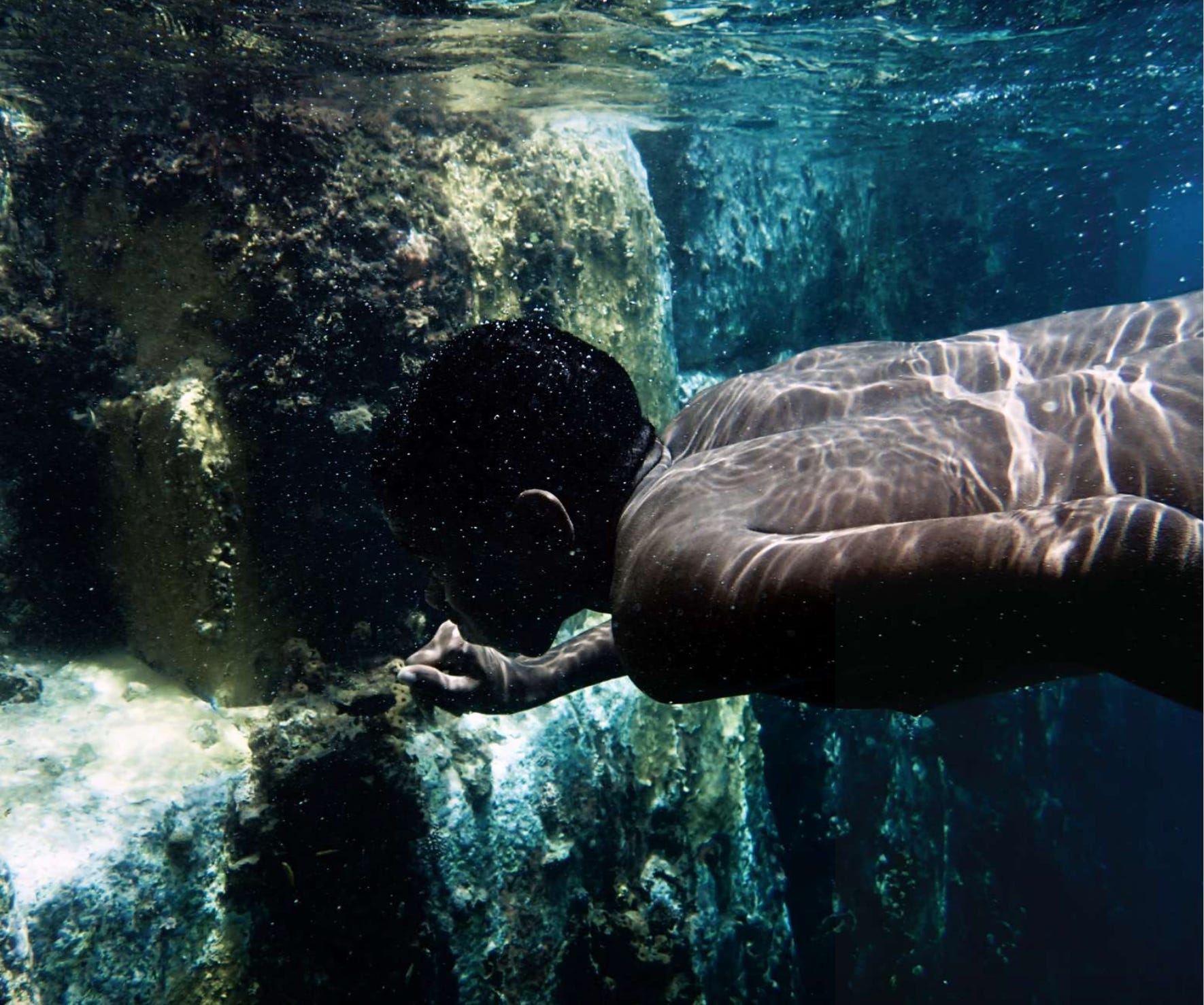
When I scuba dive, I let my hair out. It flares behind me in the blue. My breaths are loud and exaggerated in my ears, shimmering shifting bubbles rising up as I descend. Later, I may regret not tying back my hair, when I return home and find it tangled as seaweed and tightly, frizzily bunched up from the salt. But in the moment, it’s worth it. I feel a sense of power, of beauty, of wonder. In the water, I feel, if not weightless, a particular blend of lightness and gravity, a soft cool pressure in which I feel freer than ever. Under the sound of breath and the deepening blue, I forget my ghosts, for a bit.
I breathe slowly, like someone repeating an old mantra.
GABRIELLE BELLOT is a staff writer for Literary Hub. She grew up in the Commonwealth of Dominica. Her work has appeared in the New Yorker, the New York Times, The Atlantic, The Guardian, Shondaland, Guernica, Slate, Tin House, the Paris Review Daily and the Caribbean Review of Books.