

Stranger’s Guide explores how politics, power and culture shape daily life across the globe. We believe that local writers, journalists and thinkers are best equipped to explain their political and cultural realities and we publish stories that ask us to listen to the complexities of the world.
Weekly Long Read is for everyone but it’s made possible by our paid subscribers. Thanks to those who support our work, and if you’re not yet a paid subscriber, today is the perfect day to join!
Eating in Exile
by Jason Rezaian
Stranger’s Guide: Tehran
Most Americans born in the 1970s knew Iran only through a fuzzy understanding of the geopolitical dramas that played out between Washington and Tehran, personified by grainy television images of angry, bearded-men half way around the world calling for “death to America” throughout our childhood.
Members of the growing diaspora community of Iranian Americans that mushroomed mostly in Southern California following the Revolution in 1979, meanwhile, were steeped in the culture from birth. The enmity directed at many of them because of their origins encouraged insular attitudes that, for most, delayed true assimilation into American society.
But for people like my brother and me, the hybrid products of a mixed Iranian and Midwestern American marriage, our understanding of Iran was rooted almost entirely in what we ate when we were with our dad’s ever-expanding family of recent arrivals.
For us, Iranian food was just food. It was as much a part of our diets as burgers, pizza or spaghetti.
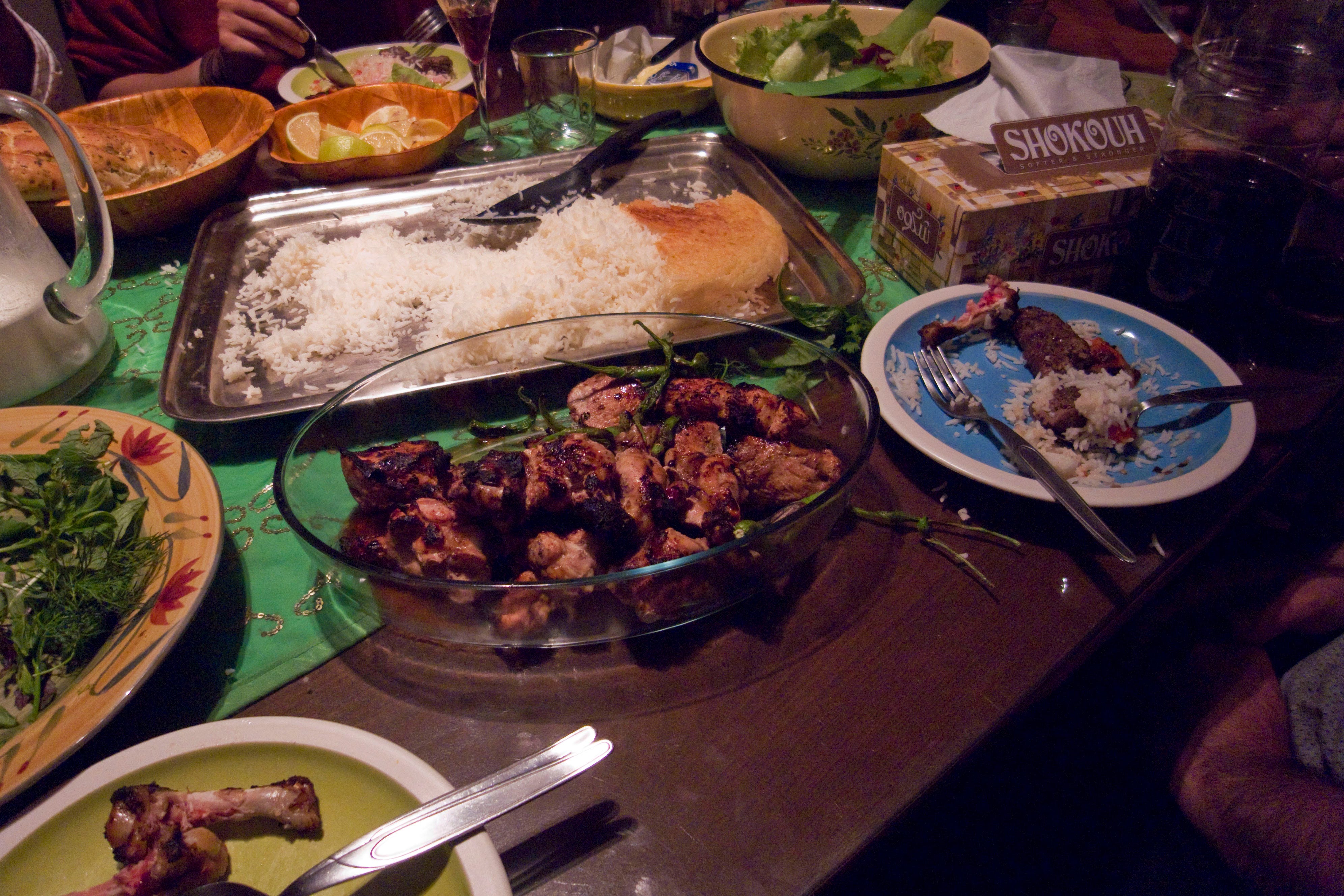
My Persian language skills were limited to the greatest hits from my Aunt Mimi’s kitchen—ghormeh sabzi, tachin, lubia polo—and related dinner-time vocabulary, like the words for spoon and fork and the Iranian equivalent of “come and get it.”
Although our Iranian relatives bemoaned the fact that the sons of the Rezaian family’s local patriarch knew so little about the ways of our fatherland, I’m now convinced that’s precisely why I ended up being the lone member of our large extended Northern California family to make the reverse migration back to the homeland.
Had I spoken the language, I might have known better. I would have understood that, for as poetic and hospitable as Persian and its native speakers can be, sometimes Iranian kindness is not exactly as it appears.
But Iran, just like its most evocative dishes, has a magical allure. I would never call myself a foodie, but there are few things I love more than a good meal. Experiencing new flavors is increasingly what gets me the most excited about traveling to new destinations.
When I began going to Iran in 2001, though, it was with a craving for tastes I already knew. Ones that I wanted to explore more deeply. Many people who have heard the story of how I was arrested, falsely charged with espionage and imprisoned believe—mistakenly—that I went to Iran to connect with my roots.
In fact, it was more about satisfying that hunger.
Iran was the ultimate destination. It kept calling me back until I decided to move there in 2009 to chase my dream of being a foreign correspondent. Along the way, I got to know the country, its people and what they ate. Through all the big news stories and the heartache I experienced there, it was Iran’s comfort foods that kept me going.
As my appreciation for my fatherland’s cuisine developed, there were certain facts that took root and became part of my own Persian culinary exceptionalism. No tradition does eggplant better than Iranian. Our multi-step method for preparing rice, which elicits the fluffiest grains anywhere, is why we eat such prodigious amounts of the stuff.
One thing I learned quickly was that Tehran is not a city known for its restaurants. If one doesn’t know where to look, it might seem as though kebab shops serving the same three types of grilled meats and American-style fast food joints were the only options.
Invasions of foreigners, like the one that happened in Iran in the years before the 1979 Revolution, alter a local food landscape. By the time I first visited Iran in the early 2000s, locally owned burger shops—often knock-offs of American chains—were popping up all over Tehran. Pizza, fried chicken—known in Iran simply as Kentucky—and ketchup had been fixtures in Iran since before the Revolution, when thousands of Americans lived and worked in the capital.
Political realities in the country had evolved, and there was an openness for Iranians living abroad to come home. The truth is that Iran needed the infusion of foreign currency we brought with us. So there was a sharp increase in the number of first-generation hyphenated Iranians like me returning to experience the place many of our parents had been forced to flee decades earlier. In many cases, the only things that remained untouched from those times were the foods of the past.
Many of those young Iranians returning from abroad were wowed by fancy kebab restaurants: white-tablecloth places like Nayeb or Alborz, with its famous, meter-long skewers of meat.
For me, though, as with so many places I’d visited in the past, in Tehran I gravitated toward humble utilitarian spots. Lunchtime workers’ cantinas and the more dimly lit joints. Places so confident in what they dished out that they needed no extra frills to impress.
Places like Arvand Kenar in the heart of Tehran on Valiasr St., the city’s main artery and the longest road in the Middle East. Home to an incredible baghali polo, fava bean and dill rice cooked in lamb tallow and served with slow-braised lamb shank or neck.
Or Hani Parseh, a cavernous subterranean space that feels like a school lunch cafeteria complete with plastic trays, only the buffet line is serving up Iran’s greatest hits. Doing so many dishes and doing them well, it was one of the very few places in Tehran from which a vegetarian wouldn’t walk away hungry. Their ash e reshteh, a hearty noodle, legume and herb soup, and kashk e bademjan, pureed eggplant topped with whey, fried mint and garlic served scooped up with flatbread, helped more than one non-meat-eating visitor survive this carnivore’s paradise.
But my all-time favorite is Etminan, a place so sure of its product the owners named it “Guarantee.” Tucked inside the capital’s smaller northern bazaar, in the Tajrish neighborhood, Etminan is nondescript and unassuming, except for the lunchtime line out the door. Khoresh e gheimeh, a stew of lamb, lentils and tomato broth covered in a tiny mound of fries is a standout, as is their koobideh kebab, the ubiquitous minced meat skewer that is rarely this good, shorter in length but much longer in flavor than many of its more expensive rivals.
Finding the best meals and feeding foreign visitors was more than a hobby for me. I prided myself on it. Whether the visitor was a journalism luminary, like my college professor and friend Christopher Hitchens, whom I guided on his lone trip to Iran, or younger reporters just starting out who managed to get to Iran but didn’t know where to find or couldn’t afford a decent meal, I fed them all.
By the summer of 2015, as Iran and world powers negotiated one of the biggest diplomatic agreements of the young millennium, I was thinking about pivoting from being a newspaper reporter to becoming a culinary guide, because I knew my employers would never allow me to do both. Objectivity would be at risk, for as I would soon learn, food is no innocuous subject.
When my wife and I were arrested, I had just shot a scene with Anthony Bourdain for his CNN show, Parts Unknown, weeks earlier, and I was preparing for the arrival of Andrew Zimmern, for whom I would be a field producer on an episode of his show, Bizarre Foods.
Suddenly, incomprehensibly, I was arrested and thrown in prison, accused of being a spy and held hostage for 544 days, released on the same day that the nuclear deal was implemented. Throughout my months of interrogations, my reporting on the food eaten in Iran came up more than once. They accused me of infiltrating Iranian society, and one way they claimed I did that was through writing about food. As if the national cuisine was a closely guarded secret like the Islamic Republic’s nuclear program. I laughed at the thought, but they were serious. Or, at least, they claimed to be.
Due to that surreal yet very real ordeal, as much as I love Iran, I can’t advise you to travel there. But if you find yourself visiting that country, I promise you can eat well, if you know where to look.
If you never get there, though, that’s okay, too; as Iranian food outside of the country is finally receiving the reception it deserves. The good news is that you don’t have to travel to Iran to have phenomenal Persian food.
Back in the US, I’m trying my hand at some of the classics. I make a mean fesenjan, a slow cooked stew of walnuts, pomegranate molasses and chicken. And I do it from scratch, cooking the walnuts down until their oils provide a vehicle for sautéing the other ingredients.
My rice game and my tahdig—the cultural treasure found at the bottom of a pot of Iranian rice—are stronger than I ever imagined they could be. I get requests for my doogh, a salty and frothy yogurt drink that’s way better than it sounds. The key is in the right amount of dried mint used to enliven the drink. Herbs are a pillar of Iranian cooking.
When I walk into my local Persian market to stock up on the key ingredients of our food—one my predecessors in diaspora couldn’t source when they arrived four decades ago—I feel lucky. Nearly everything one needs to make even Iran’s most obscure dishes can be found on both coasts and often online.
I also feel heartbroken, though. I’m now just one more Iranian in a long line of us eating in exile. No amount of perfectly cooked rice or eggplant, nor the freshest herbs, can dull that bitterness. And yet we still try.
JASON REZAIAN is a writer for the Washington Post’s Global Opinions. He served as the Post’s correspondent in Tehran from 2012 to 2016. He spent 544 days imprisoned by Iranian authorities until his release in January 2016. He is a CNN contributor.
Great writing. No recipes? How to make that eggplant? I cook lots of eggplant, many ways. Mostly Italian or American-Chinese. What is a Persian eggplant recipe?