

Olympique de Marseille
Sean Jacobs on the football team that is the face of modern France
Stranger’s Guide explores how politics, power and culture shape daily life across the globe. We believe that local writers, journalists and thinkers are best equipped to explain their political and cultural realities and we publish stories that ask us to listen to the complexities of the world.
Weekly Long Read is for everyone but it’s made possible by our paid subscribers. Thanks to those who support our work, and if you’re not yet a paid subscriber, today is the perfect day to join!
Olympique de Marseille by Sean Jacobs. Stranger’s Guide: Mediterranean.
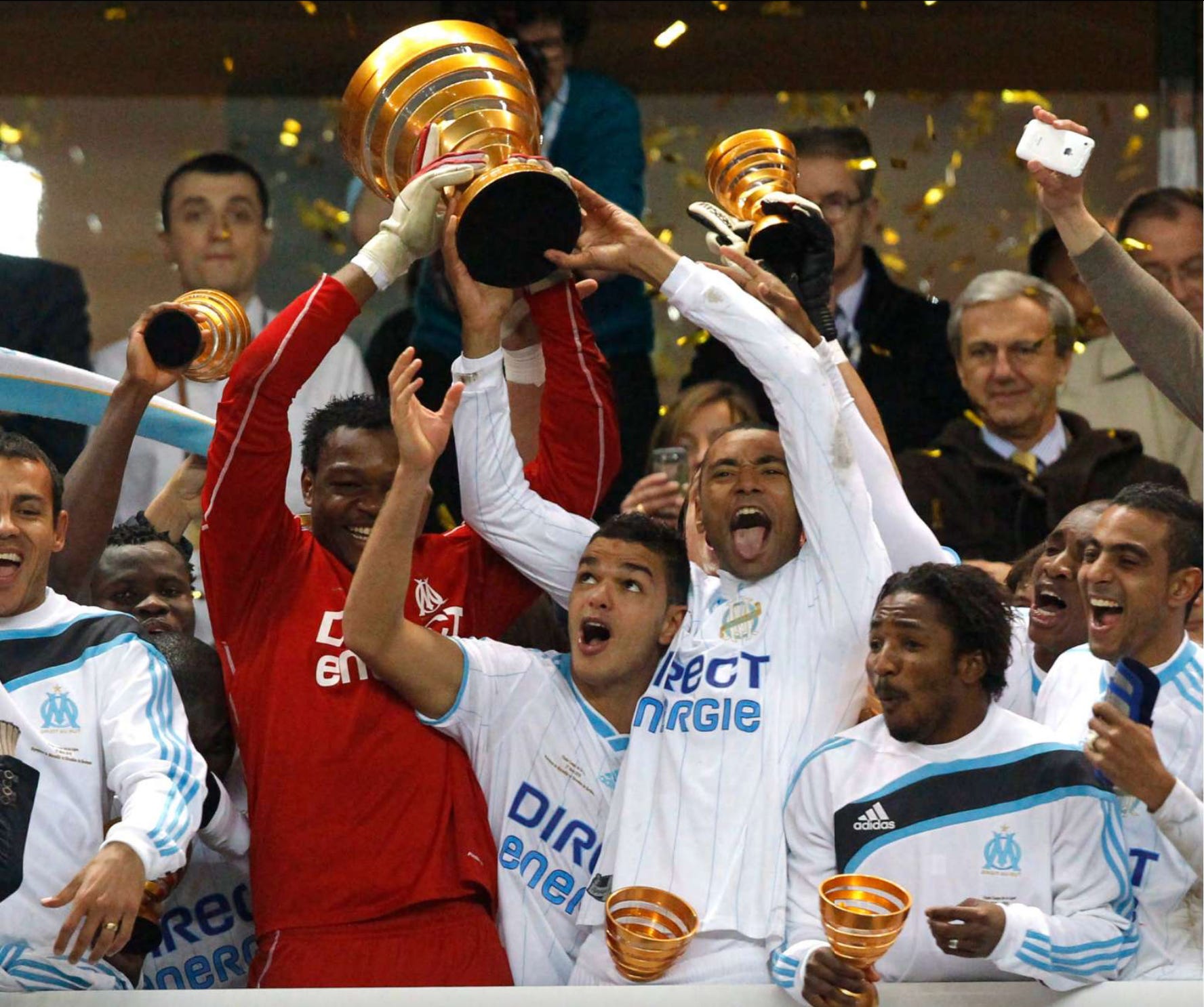
Marseille, like other port cities, is a place fundamentally shaped by migration. This defines its national character, both as a French city and as a home to a French football team. Paris, the French capital, is thought of as "French" the way Hollywood constructs it: a city of high culture and fashion, a white city in which Arabs and Africans are relegated to the margins and banlieues, outsiders who only come into sight when they demand rights from the police and the state. Marseille, by contrast, is less segregated; the aspiring bourgeoisie moved 40 minutes away to Aix-en-Provence. Just a few blocks from Marseille's tourist trap port is the 13th arrondissement, where Arabs, Comorians and Senegalese mill outside mosques, stores and street markets. Of course, the racial and class inequalities of any major city persist here too. But while the cliché holds that Marseille is not France, the truth is that Marseille approximates more the real France. This is the France of Arabs, Africans, Catalans, Corsicans and even the regressive white nationalists from the Rassemblement National, which calls Marseille and its wider region their base, as well as the countless others who came to make and remake the city in their own image. The same can be said for the city's main football club, Olympique de Marseille (OM).
Founded at the end of the nineteenth century, OM plays in sky blue and white. Unlike most of the traditional regional powerhouses of French football, which dominate in one specific era, Marseille spread its titles over the decades in a series of booms and busts. Now, they're faced with the monied behemoth that is Paris St.-Germain (PSG), hardly a factor until the late 1990s. OM is forced by television promoters to be junior partners in what is now France's most important club rivalry.
I grew up in Cape Town, South Africa, and discovered OM when I was in university in the late 1980s. With South African football banned from continental and international play, fans like me had no option but to dream vicariously through European teams, especially squads with working-class origins or that had African players who distinguished themselves. The rule in club football is that you can support only one club per country. For teams outside South Africa, I gravitated toward clubs from port cities like the one I grew up in. I first chose Liverpool because my dad had supported them since the early 1970s. I also went for Napoli in Italy (blame Diego Maradona) and Borussia Dortmund in Germany. And, of course, Olympique de Marseille. Coming from South Africa, I was drawn not only to the team but to the spirit of its city.
I loved OM for its cosmopolitanism, chaos and passion. Marseille's active relationship with North Africa contributes to this sensation.
Historically, Marseilles has been in tension with Paris and with a notion of a larger French identity that it rejects. Louis XIV famously had a fort built in Marseille harbor that still stands today: its cannons face the city. In the telling of Marseillais, Paris makes all the decisions, has all the museums and produces much of the culture that France and the Francophonie consume. Also, the money flows out of Paris. Marseille, by contrast, has been a port city for more than 2,500 years. If it has a worldliness, it came from its working classes. Originally a Greek colony, in earlier generations white workers from Italy, Greece, Spain and further afield were recruited to work in its docks. Later dockworkers came from West and North Africa. If Paris nurtured the cultural cosmopolitanism of Léopold Senghor, Aimé Césaire and James Baldwin, Marseille helped shape the Marxist films of Ousmane Sembène, a dockworker in its shipyards. The city became a meeting place associated with OM and the populace. Not surprisingly, the city managers embraced this character for its publicity campaigns.
In the late 1980s, OM, frustrated by its failure in European competitions, set out to rebuild its team and did so by drawing on African and African-descended players. Abedi Pele, the small attacking midfielder from Ghana, arrived for the 1989 season and is arguably the greatest African player of his generation. Defender Basile Boli was born in Ivory Coast and migrated with his family to Paris as a child. After starting his career at Auxerre, he was signed by Marseille in 1990. Then, there was Marcel Desaily, also born in Ghana but a product of French youth football, who anchored the defense with Boli. Even François Omam-Biyik, who as a member of Cameroon's national team put Maradona and Argentina to the sword in the opening match of the 1990 World Cup, was on the squad. An assortment of French and European stars captain Didier Deschamps, goalkeeper Fabien Barthez, Chris Waddle and Rudi Voller rounded out the team. Between them, these players won four French Ligue 1 titles in a row and appeared in two European finals. They had their greatest triumph in 1993, when they won the Union of European Football Associations Champions League title. Boli scored the match's only goal against an AC Milan team that featured world-class players Paulo Maldini, Franco Baresi, Frank Rijkaard, Marco van Basten and Jean-Pierre Papin, who was transferred from OM to Milan the year before.
In line with its immigrant sensibilities, OM would later distinguish itself by becoming the first major European club to appoint an African president, the Senegalese Mababa "Pape" Diouf. Diouf had arrived in France as a young man, and after a career as a journalist, he became a sports agent. He recommended players like Desaily and Boli to OM. (His other later clients included William Gallas, Didier Drogba and Samir Nasri, all former OM players who went on to make it big in the English Premier League.) Diouf was hired as Marseille's general manager in 2004 and was appointed president a year later; he held the post until 2009. It is telling that since then, there has yet to be another Black or African president of any major European football club. Although the club didn't win the league or a European championship under his presidency, Diouf is revered by the club's fans, the plurality of whom are a mix of Africans and Arabs. Sadly, Pape Diouf died in March 2020 of COVID-19; he had retired in Senegal. On the OM website, his former team wrote, "Pape will remain forever in the hearts of Marseillais as one of the great craftsmen of the history of the club."
Those familiar with Olympique de Marseille might accuse me of being blind to the stink associated with the club. The team's rise in the 1990s was paid for by a Trump-like businessman, Bernard Tapie. Gerard Depardieu played a version of Tapie in the TV series "Marseille." After OM's great 1993 European triumph still the only continental championship by a French club it emerged that before the final, OM bribed players of the opposition, Valenciennes, to take it easy during a league match. The objective was to not exert OM's best players for the champions league final. For this sin, OM was relegated to the second division, and Tapie and two other club officials were banned from football. Arsene Wenger, who managed AS Monaco at the time, called Olympique de Marseille "gangrenous."
To some, OM and Marseille as a city are hard to pin down. The club is often dismissed as not having a style of play (the "Nantes style," say), and those who've played there find it hard to put the experience into words. In his autobiography, Didier Drogba, who played there for one season in the early 2000s, could only muster feeling "a sort of out-of-body sensation" as he entered the Velodrome each week on match day to 60,000 screaming fans unfurling tifos with his name on it.
Tellingly, he writes that it was while playing at Marseille that he came up with his unique post-goal celebration: imitating the fast dance moves of Ivory Coast's coupé-décale. It may be that Drogba felt comfortable and bold enough to introduce the dance at OM, knowing its fans would not ridicule or other him. He is like them.
In the last decade or so, American and Russian businessmen, along with princedoms from the Persian Gulf, have been buying up European football clubs. In 2016, Frank McCourt, the former owner of the LA Dodgers baseball team, became the majority shareholder in OM. McCourt threw lots of cash into the team, but the results didn't follow for a few seasons. Under new manager Andre Villas-Boas, OM had climbed to second place in Ligue 1 behind PSG and was on course for a return to Champions League football when the French government cancelled the remaining games because of COVID-19. But reflecting the Mediterranean's pull on the city and its football club, McCourt's ownership is being challenged by a Tunisian businessman, Mohamed Ajroudi. If Ajroudi succeeds, he'll be the first Tunisian, and even more significantly, the first North African owner of a French football club, which would also reflect the city and the club's open character:
No other city in southern Europe on the Mediterranean has as many Arabic speakers or as much of a transnational culture as Marseille. The pull of North Africa is visible in the styles people wear, the active family relations across the sea and the media most of them consume, whether online or via satellite dishes sticking out their windows or off the roofs. Perhaps the clearest sign of these connections is how, right before and during the height of the coronavirus pandemic, one could watch the constant flow of everyday people with groceries and furniture tied to the tops of their cars on ferries heading back and forth to Algiers, some of them proudly sporting their light blue and white OM football tops.
SEAN JACOBS is editor and founder of Africa is a Country, a site of opinion, analysis and new writing. He is a native of Cape Town, South Africa.
 | A guest post by
|
Thanks for putting the piece online! Can you link it to my author handle?